Ian Gibbins | 00:03:49 | Australia
English
“corzee mol o emarlm eszee … tsnyora snook snay nornse … forcanlows sekmalafair nischniss seconlyaire”
Although Physalia, the Portuguese Man O’ War, with its gas-filled float and tentacles bearing venomous stings, resembles a jellyfish, “like all siphonophores, it is a colonial organism made up of smaller units called zooids.” (Quoted from en.wikipedia.org/wiki/Physalia)
“Physalia” is derived from a Latin word meaning “bubble” or “bladder”. Its stings (nematocysts) create intense burning pain and its neurotoxins can cause paralysis.
The “Man Of War” was a sailing vessel developed by the Portuguese in the 16th century as a powerful warship, heavily armed with cannons. They were widely used by other European colonialists, including the British, French, Spanish and Dutch, well into the 19th Century. The strength of the Portuguese navy was instrumental in acquiring and maintaining its colonial empire from the 15th century until the 20th century when the last remnants of the empire were decolonised.
Physalia is highly successful organism, widespread across the world’s oceans. Nevertheless, its environment is under increasing threat from pollution and climate change. Its potent armoury of highly toxic stings is no match for this type of attack. Perhaps new forms of cryptic colonial zooids may evolve to reverse the damage… If they had the words, what would they tell us?
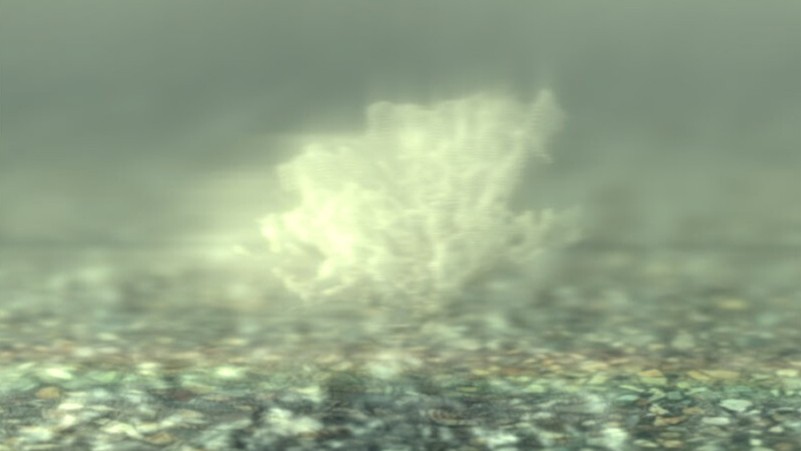
All the spoken text and its on-screen transcription is derived from mirror images, reversals and reflections of the Wikipedia quote. The Physalia biomorphs are variously constructed from Particle Illusion (Boris FX), coralline red algae, Muntrie flowers and Eucalypt flowers.
Primary source locations include Tarndanya / Adelaide CBD and parklands, Karrawirra Pari / River Torrens, Yertabulti / Port Adelaide, Kuarka-dorla / Anglesea River, and Kaarta Gar-up / Kings Park, Perth on the unceded lands of the Kaurna, Wadawurrung and Nyoongar peoples. Many of the buildings illustrated here date back to colonial 19th century Australia.
Writer
Ian Gibbins